PREDICT THE WORLD. CONNECT TO ACTION.
World-Action Modelsfor Robot Learning and Control: A Survey
A robotics-oriented review of models that connect future world prediction
with executable action generation.
Abstract
Robots operating in open environments act under partial observability, physical constraints, and dynamic task contexts. Beyond mapping observations and language instructions to actions, they must anticipate how candidate actions may affect future states and task-relevant outcomes. Recent advances in world models, video generation, and Vision-Language-Action (VLA) policies have motivated the development of World-Action Models (WAMs), which couple future world prediction with executable action generation. This survey provides a robotics-oriented review of WAMs. We clarify their scope relative to conventional world models, model-based reinforcement learning, action-conditioned video generation, and reactive VLA policies, and organize existing methods through a unified taxonomy covering representations, transition modeling, action interfaces, architectures, training pipelines, data modalities, and scaling strategies. We further review applications of WAMs in manipulation, navigation, and autonomous driving, and we summarize the datasets, benchmarks, metrics, and protocols used to evaluate WAM systems. Finally, we discuss key challenges in action alignment, world-action factorization, spatial and multi-view consistency, long-horizon memory, neural simulation for closed-loop policy learning, and efficient inference. Taken together, this survey aims to provide a concise technical foundation for integrating predictive world modeling with action generation, toward more reliable embodied robot intelligence.
Overview
World-Action Models (WAMs) connect future-state modeling with executable action generation to support predictive robot control. World models learn how the environment evolves, often conditioned on actions; VLA policies map observations and language to actions. In our survey, WAMs connect these capabilities within a shared learning or inference process, so action generation is informed by predicted consequences.
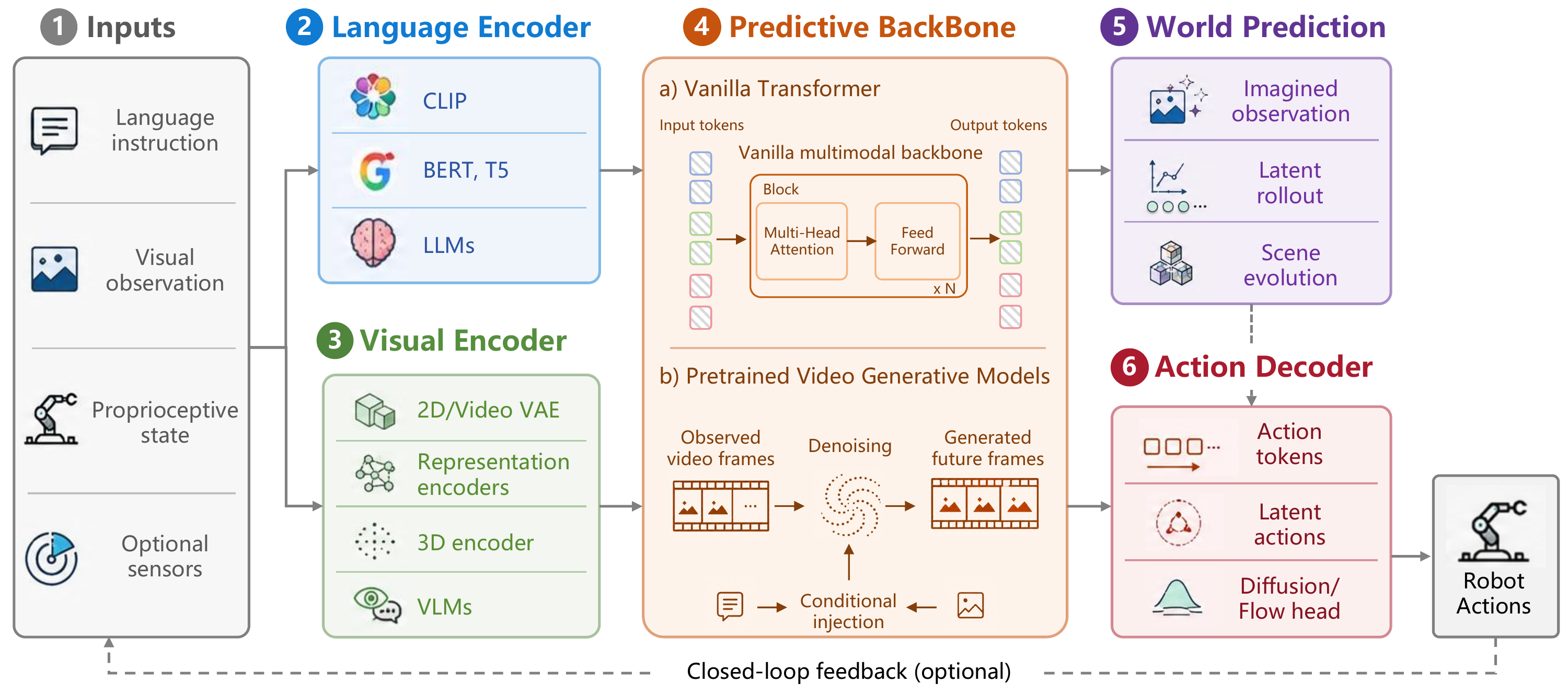
Architecture
We categorize WAMs along two independent axes: architecture and transition modeling. One Model uses a shared backbone, while Dual-system separates world and action experts. Joint prediction couples future observation and action generation; inverse dynamics (IDM) predicts future states and then infers executable actions. Some IDM-style systems learn this interface implicitly and decode actions without explicitly generating a full future rollout at inference.
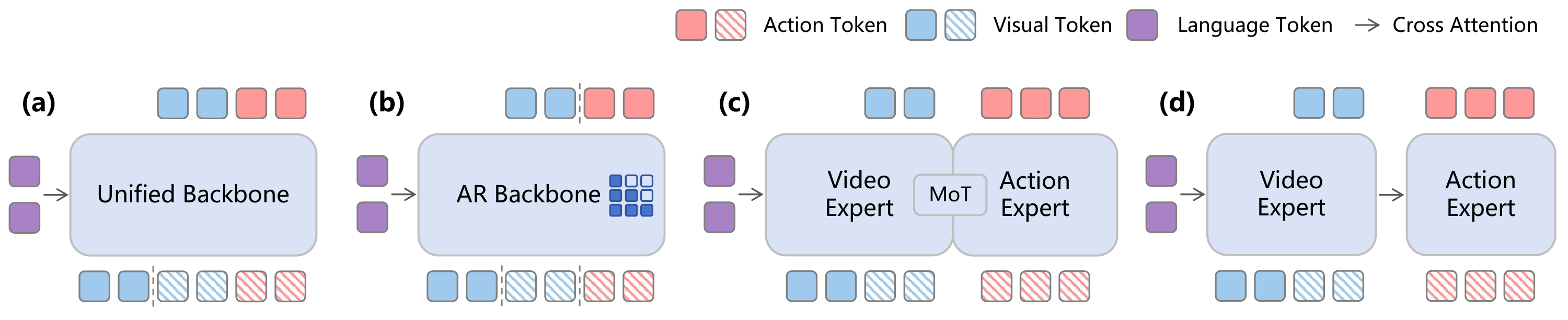
Training and data
Training WAMs generally follows a two-stage pipeline: pre-training and post-training. Pre-training learns spatiotemporal and action representations from large-scale video data, while post-training adapts the model through fine-tuning, data augmentation, and reinforcement learning. Different data sources provide complementary supervision: internet videos and egocentric demonstrations mainly provide visual dynamics priors, while embodiment-specific trajectories supply direct action supervision.
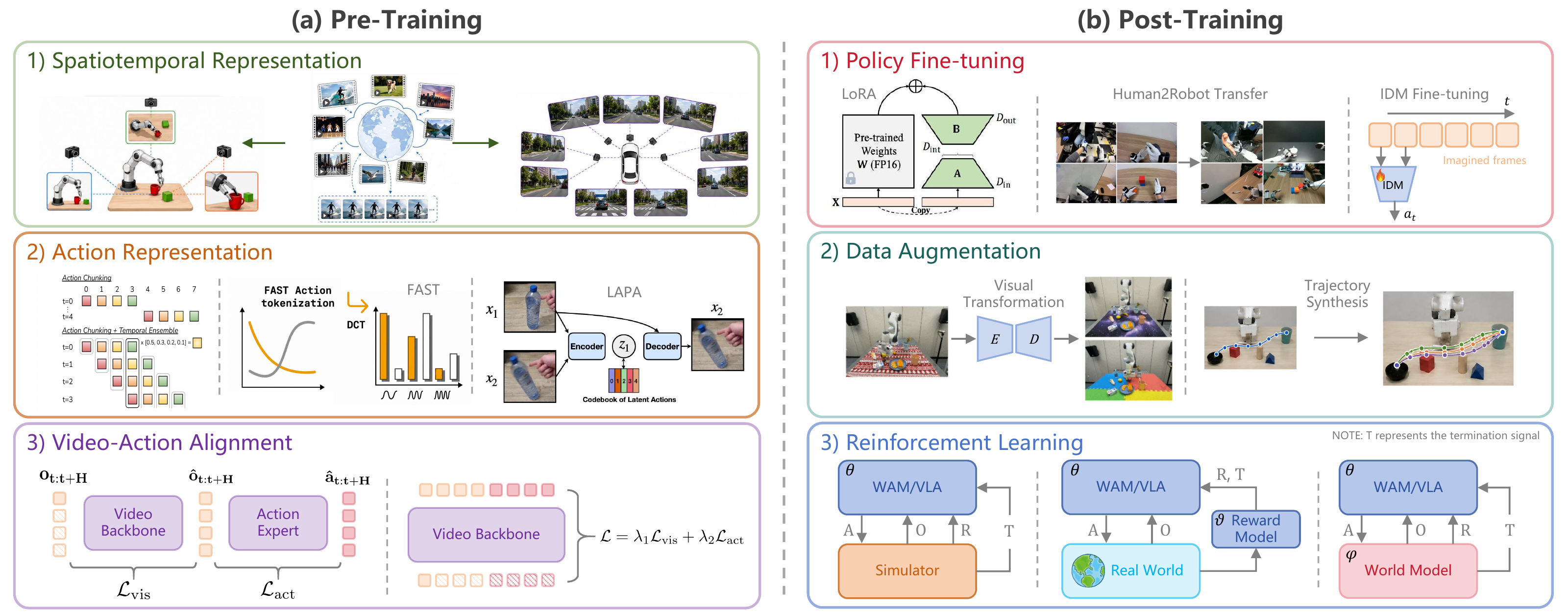
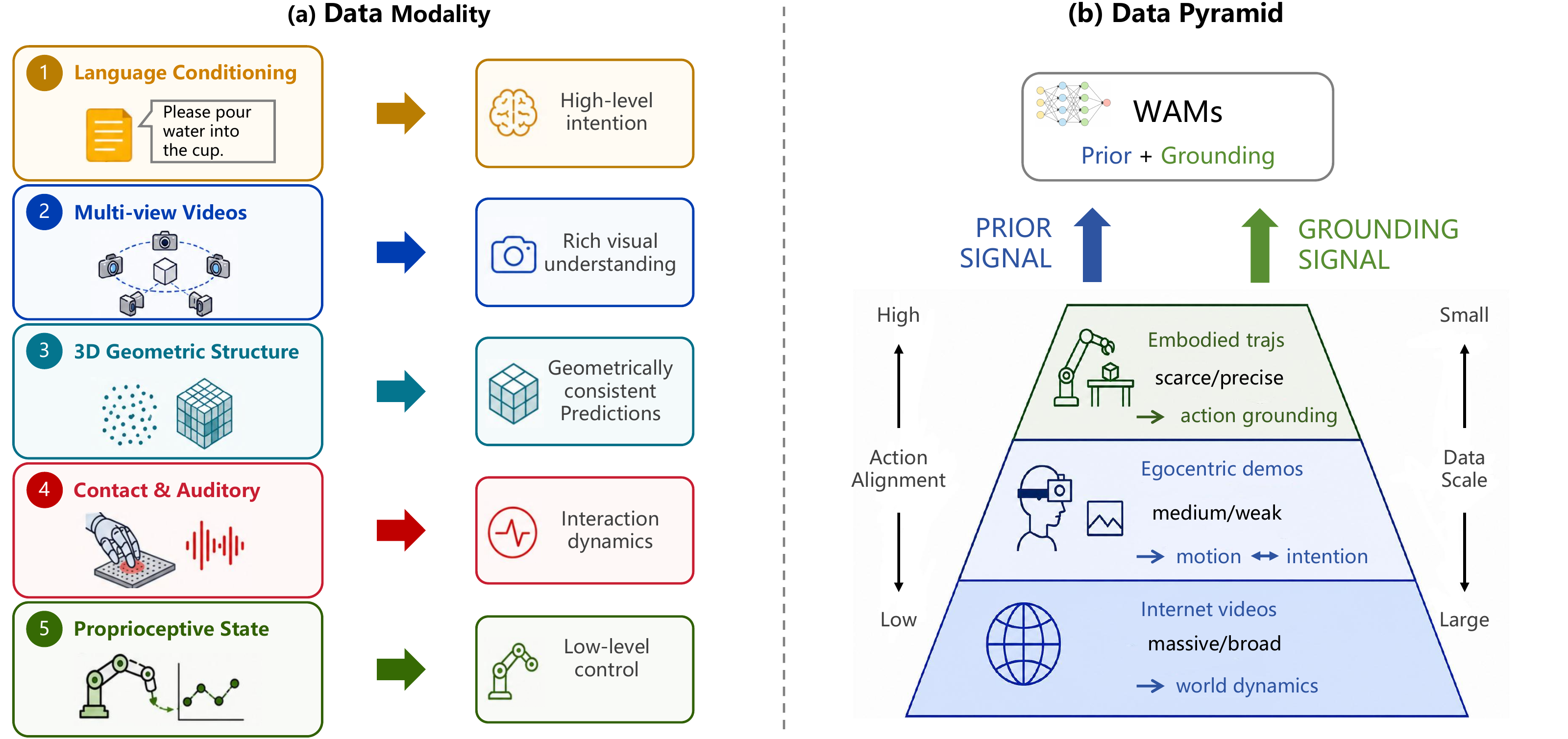
Applications
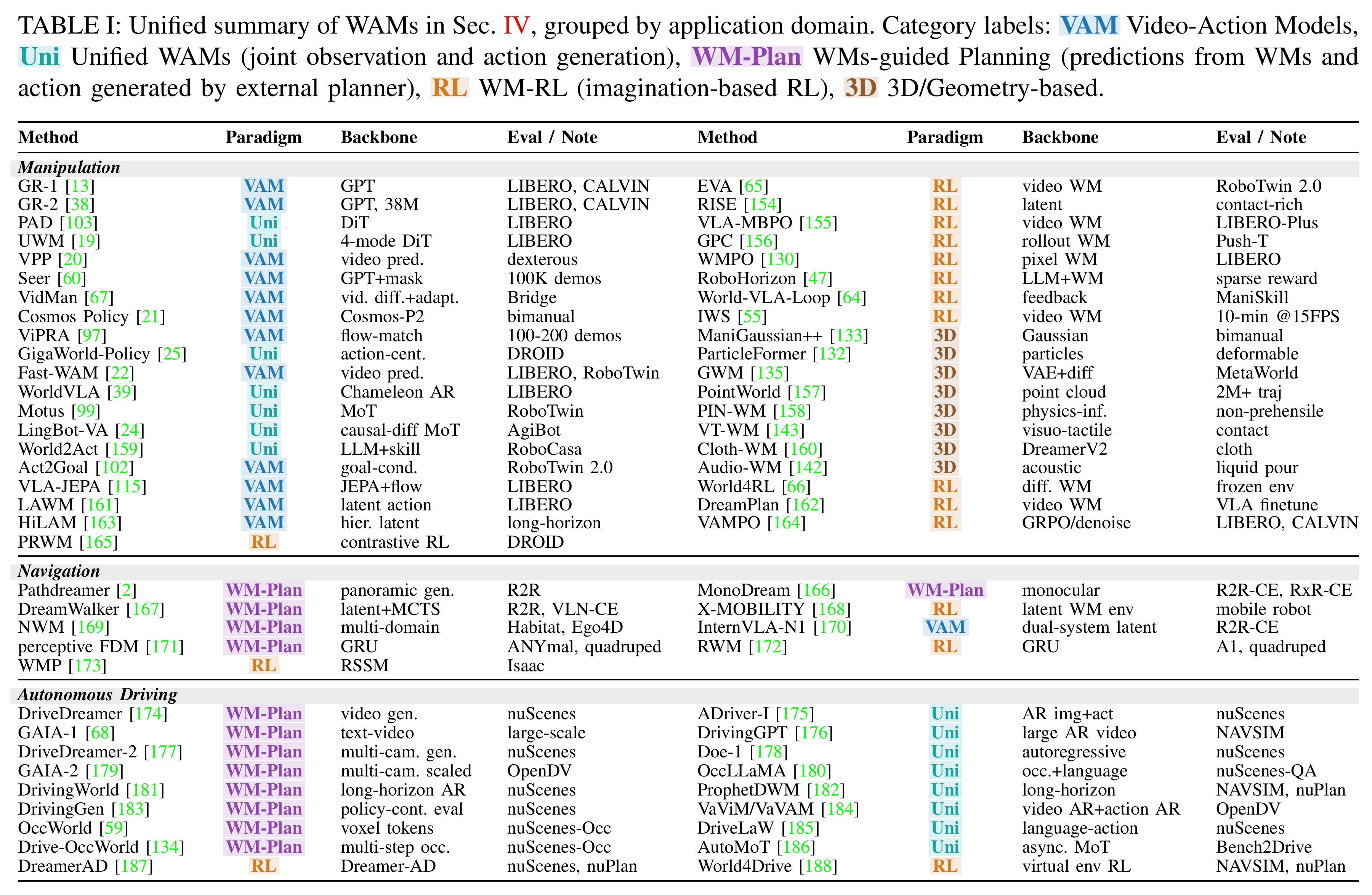
WAMs are used differently across embodied domains. Their value may lie in representation learning before policy training, in imagined look-ahead during inference, or in synthetic trajectories used for policy improvement. We therefore organize this section by application domain, including robot manipulation, navigation, and autonomous driving, and examine the role that prediction plays in each domain.
Citation
If you find our survey or WAMs resources useful in your research, please cite our paper.
arXiv:2609.16074 [cs.RO]